
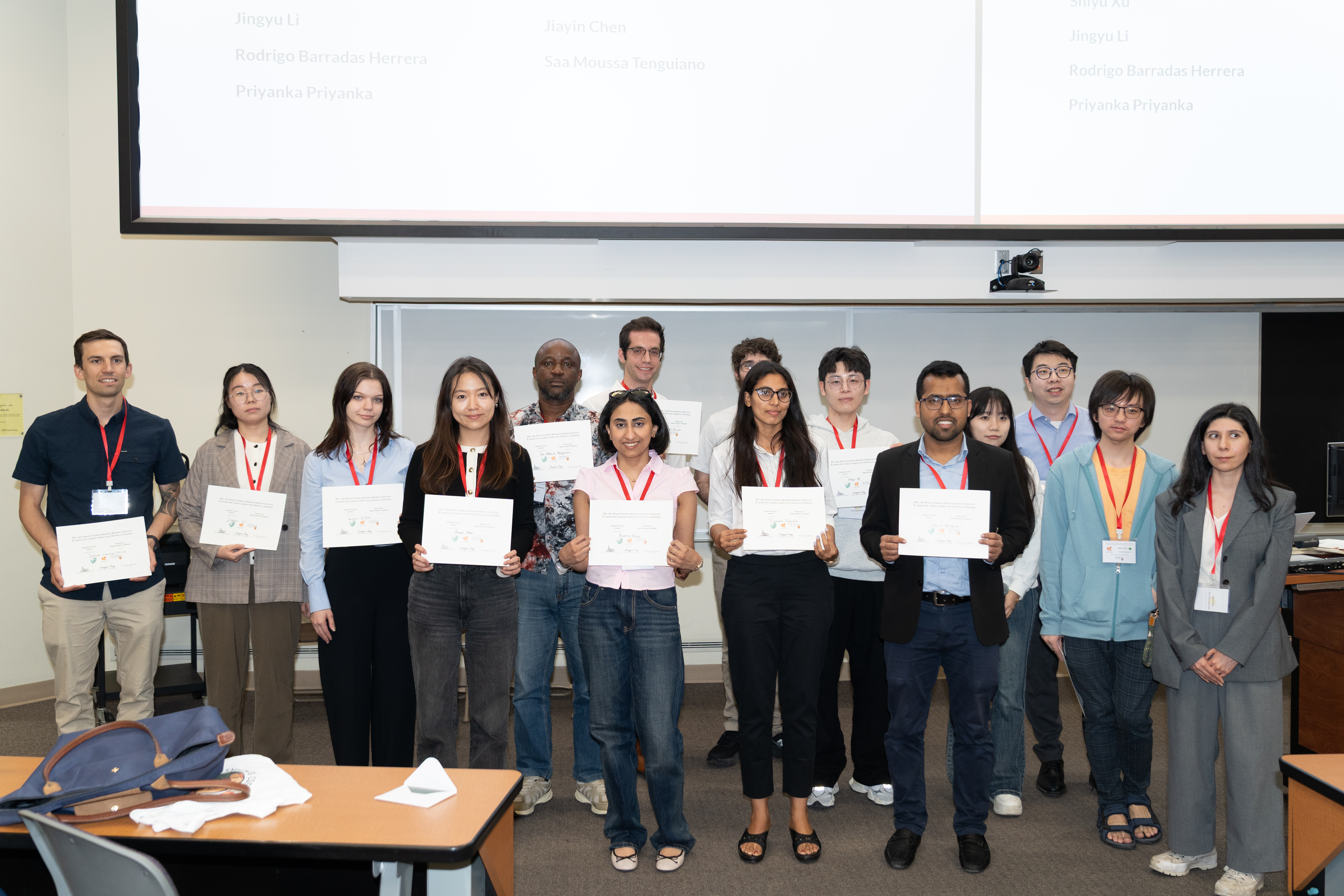
Received Travel Award for presenting at the Canadian Statistics Student Conference (CSSC)
Poster
Award Ceremony
I am a MSc candidate in Statistics at Simon Fraser University, advised by Dr. David Stenning. My research lies at the intersection of Bayesian inference, fast approximation methods, and scalable samplers. I am broadly interested in developing principled statistical methods that are computationally efficient and theoretically grounded.
Before my Master's, I completed a BSc in Statistics at the University of Delhi, India. I enjoy learning about faster and scalable algorithms with theoretical backing. Recently I've been learning about MCMC samplers, GPs and Deep GPs and am exploring their applications in astrostatistics.
Outside of research, I enjoy hiking, swimming, and teaching. I have dabbled a bit into cubing and some logical puzzles. I enjoy live music and my favourite thing to do is to read on a sunny day.
News
Poster accepted at the Canadian Statistics Student Conference (CSSC)
I will be presenting some findings from my Master's research.
Awarded Graduate Fellowship — Spring 2026
Support for my Master's research and academic pursuits.
Presented at Canadian Celebration of Women in Computing Conference (CAN-CWiC)
I presented a simulation study that motivated my Master's research in this presentation.
SlidesAwarded Graduate Fellowship — Summer 2025
Support for my Master's research and academic pursuits.
Projects
Master's Thesis (Ongoing)
Emulation and Bayesian Calibration of Stellar Evolution Models Using Deep Gaussian Processes
Stellar evolution models are fundamental tools in astrophysics; these models exhibit complex, nonstationary behavior, particularly in late evolutionary stages. This makes direct calibration to observational data challenging and computationally expensive. We develop a statistical framework for emulation and calibration of stellar evolution models using Deep Gaussian Processes (DeepGPs). To efficiently incorporate the high-dimensional and non-stationary simulator response surface, we fit a DeepGP emulator trained on simulated stellar evolution data. The emulator takes as inputs physical properties of a star and outputs the expected brightness in several wide wavelength bands of light. We adopt a multi-stage, modular approach to both emulation and calibration, allowing for pragmatic inference while retaining uncertainty quantification. Results demonstrate a robust framework, confirming that DeepGP emulation facilitates the capture of non-stationary structures in stellar evolution tracks.
Deep Gaussian Processes Bayesian Calibration AstrostatisticsSupervised by: Dr. David Stenning · Introductory Slides Poster
Other Projects
SimpleGPT: Autoregressive Language Model from Scratch in JAX
Implemented a GPT-style transformer from scratch in JAX and Flax, without using any high-level model libraries. The architecture includes multi-head causal self-attention, learned positional embeddings, and stacked transformer blocks with pre-norm residual connections. Training uses a JIT-compiled loop with jax.value_and_grad, AdamW, and cosine learning rate decay. Trained a character-level model on the Tiny Shakespeare corpus (~1M tokens); loss drops from 4.96 to 2.63 over 3000 steps with no significant overfitting.
JAX Transformers Language ModellingGitHub
Annealed Sequential Monte Carlo for Bayesian Logistic Regression
This project is a simple example that I was exploring while I was learning about SMC. It demonstrates how to use Sequential Monte Carlo with annealing to sample from posterior distributions of logistic regression coefficients. The algorithm gradually transitions from the prior distribution (β=0) to the posterior distribution (β=1), making it particularly effective for complex, multimodal posteriors.
MCMC Samplers Annealed SMCGitHub
Reduction of Small-Sample Bias of GLM Parameter Estimates
This project examines the performance of three bias reduction techniques for Maximum Likelihood Estimation in GLMs: Asymptotic Bias Correction (adjusts MLE estimates using first-order bias approximation), Firth's Method (modifies the score function to reduce bias while preserving invariance properties), and Log-F Prior Method (a Bayesian-inspired technique that allows incorporation of prior information).
Bias Reduction Firth MethodWith Samir Arora, Annie Yao · Report · GitHub
Notes
Expository notes, proofs, and reading material I have written for my own understanding or for courses.